Effort is not an edge.
Grit may pay bountiful dividends in fields like music sports, and the arts. The stock market is another story.
Frank Sinatra wrote about 1,200 songs. Of these, 209 became hits. This equates to a success rate of 17%.
Yankee legend, Babe Ruth strode to the plate 8,399 times. He managed to hit the ball out of the park 714 times. Out of his total at-bats, his homerun percentage was 8.5%.
Famed painter Pablo Picasso created around 150,000 individual pieces of art. Of these, 1,170 were hits. Picasso success ratio was 0.7%
James Dyson built 5.127 vacuum prototypes over 5 years before finding a model that worked. His success was achieved with a miniscule 0.02% hit rate.
The list goes on and on. J.K. Rowling’s Harry Potter was rejected by 12 publishers before Bloomsbury finally have her a chance. Horror author Stephen King’s classic Carrie was rejected 30 times before it became a best-seller and popular movie.
All of these examples have a couple of key facts in common. First and most important, the math of success is brutal. The few that are willing to take a beating and keep swinging away will find lasting fame and fortune.
One would assume applying these same principles to the stock market would garner the same results. This couldn’t be further from the truth.
The above mentioned strategies are based on controlling the outcome through the sheer volume of attempts. meaning if you swing enough times your own skill converts a percentage of attempts into hits.
The problem with implementing this strategy into getting rich in the stock market is clear. Even professionals inside industries cannot reliably predict in advance which specific swing will be a hit. In other words Nobody Knows Nothing
Swinging more in investing doesn’t bring an edge, only heartbreak. This is the best argument for owning a broadly diversified index of individual stocks. You can’t tell which swing counts so own everything.
Index funds don’t swing for the fences, they own everyone who does.
You don’t have to take my word for it. How about listening to Finance Professor Hendrik Bessembinder who stacked the deck against stock pickers in his famous Besseminder study.
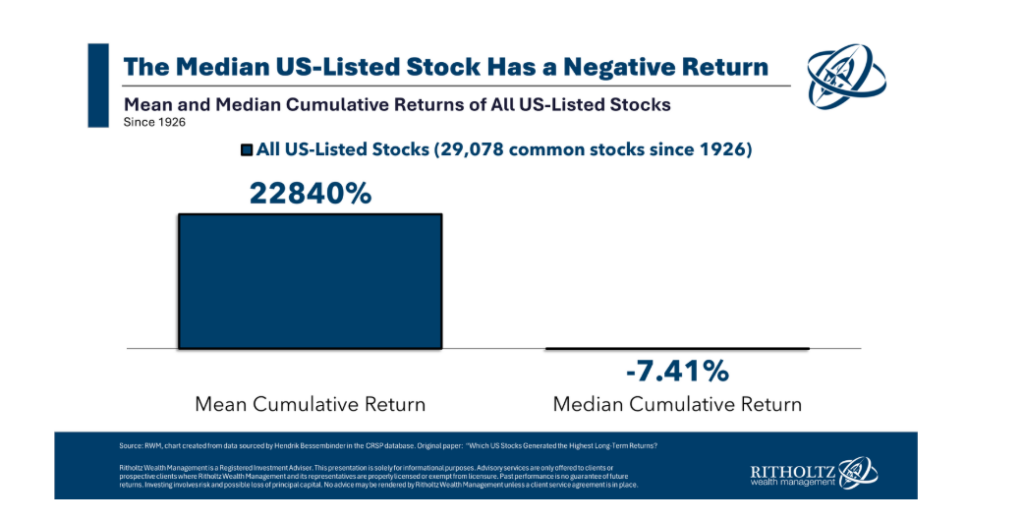
After studying every US stock listed from 1926-2016, (About 26,000 companies) he came to some startling conclusions.
- The 1.000 top-performing stocks, less than 4% of the total accounted for all the wealth creation in the market.
- The remaining 96% of stocks matched the returns of risk-free Treasury Bills.
- The top 90 firms, about 1/3 of 1% of companies, accounted for 50% of shareholder wealth created since 1926.
- The majority of stocks, 51.6% had negative returns over their lifespan.
- Using updated data in 2025, it was determined Apple and Nvidia alone each account for 5% of all market gains since 1926.
Unlike Picasso, investing success isn’t about energy expenditure. The golden rule for the mass majority of investors is understanding that nobody knows in advance the stock market’s eventual winners.
It’s hard to fathom that 96% of stocks are a waste of your precious time. Your ego has a real problem processing this statement. Investing isn’t easy. If it was we would all be rich.
Good investing is watching paint dry. Great investing is not watching at all.
Bessembinder claims first prize in the doing nothing is a strategy sweepstakes.
“The only way to be sure of having tomorrow’s big winners in your portfolio is to own all the stocks.”
The market doesn’t care how hard you swing.