What’s the real reason parents spend so much time worrying about their child’s education?
The answer may not be what you think.
Stop Paying The Status Tax!
It turns out that four things actually matter regarding your children’s future success. None arrive attached with an Ivy League label.
The answers to these questions should matter to everyone concerned about their children’s future.
Do you give your kid deep love and warmth?
Do you have a loving relationship with your partner?
Did you read to your kid when they were young?
Do you try to be healthy?
If the answers are yes, stop stressing over that SAT Prep Program.
According to Auben Hoffman:
If you can answer yes to those four, congrats! your kid is in the top 1%. on every measure that has ever been studied — income, education, longevity, marital stability, mental health — those four inputs swamp almost everything else. they are not in the same league as the school question.
Is it possible that the right school takes your kid from the 99th percentile to the 99.8th? maybe. the parental freakout treats schools as a 30-point intervention. they are, at best, a half-point one and most parents have never actually checked.
In a surprising turn of events, it turns out most good schools are good because they have good kids.
It’s all the rage amongst the wealthy to get their children into elite kindergarten programs. (Talk about two words that should never be in the same sentence.)
In reality these schools spend an inordinate amount of time screening out the kids whose parents replied No to the fantastic four.
These kids then go onto an elite K-12 school and college and the schools are given all the credit!
It’s like hand-picking a roster of All-Stars baseball players, then attributing every victory entirely to the coaches.
For colleges we can provide more numeric examples to back up these claims.
The WSJ completed a study of the 15 most expensive colleges to determine if the cost was worth it. It turns out the answer is a resounding Nyet . The rankings looked at how much a school improves earnings relative to peers, salary outcomes and relative levels of debt.
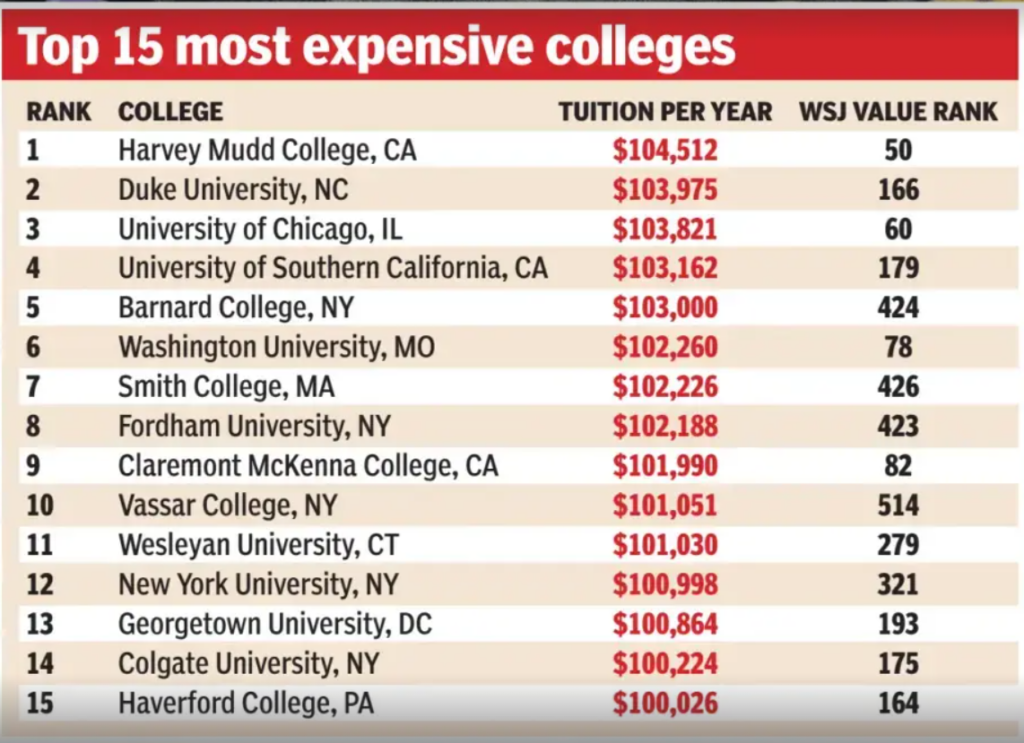
As you can see according to the WSJ value rank, these schools are to put it mildly, overpriced.
The facts clearly show that wealthy children from stable homes don’t benefit from egregious K-12 or college tuitions.
Why pay coaches up to $50K to get their kid into elite Kindergartens?
Why spend $300 an hour to boost an SAT score a few points?
Why do intelligent wealthy parents (And some not so wealthy) gladly fork over over $400k for an undergraduate degree?
It turns out elite schools are the ultimate signaling currency.
You might be surprised by how strongly the desire to show other parents that their children attend elite institutions drives these choices.
School-brand flexing is alive and well.
It’s considered gauche in most social circles to brag about how much money is in your 401(k) or the current value of your home.
Not so for schools. The last legal brag is bloviating about what school your kid attends. Obnoxious bumper stickers and hoodies are the least of it. Parents can use this as a tool to graduate into a higher social circle amongst other goodies.
Obviously not every parent is motivated by gaining status by their kid’s achievements but too many are.
It’s time to give the credit where it’s due.
Great parents, not elite schools, make great kids.
Don’t let overpriced consultants and schools convince you otherwise.